 dlapilota.pl

World statistics on Electronic Conspicuity devices by technology (March 2025-2026)
In the world of general aviation, one statement has been repeated for years: there are so many standards that, in practice, there isn’t really a single one. Electronic Conspicuity (EC) systems technologies designed to allow aircraft to broadcast information about their position, were meant to improve safety in the air. In reality, however, they have created an ecosystem where several competing solutions operate side by side. The core problem is therefore quite simple: pilots often find themselves wondering whether their device actually “sees” what is really flying nearby.
Instead of relying on manufacturers’ claims, together with Paweł Jałocha we decided to take a look at what reality actually looks like. We examined data from a global network of air-traffic receivers to see which Electronic Conspicuity technologies are truly present in the air, and at what scale.
How were the statistics created?
To reduce the impact of weather and seasonality, we compared the first nine days of March in 2025 and 2026. A nine-day period should also smooth out the effects of particularly good or particularly bad weather that could otherwise distort the statistics. We then calculated the number of aircraft that were broadcasting signals in each technology during that period. Only aircraft flying within the altitude range GND–FL95 were included in the statistics.
How to read the statistics?
ADS-B: 25 322 means that during the selected period the first nine days of March, the network recorded 25 322 aircraft that were visible via ADS-B technology up to FL95.
ADS-B: 43% indicates the share of this technology in the total number of aircraft recorded during the analysed period.
The statistics do not include MODE A/C/S transponders.

A few additional remarks about the statistics themselves
The devices (standards) included in these statistics partially overlap. For example, a paragliding device such as XC Tracer can transmit FANET signals while simultaneously broadcasting FLARM and/or ADS-L. Similarly, an aircraft may carry an ADS-B transponder while also using FLARM or Stratux, with the latter broadcasting OGN, ADS-L and even FANET signals.
PilotAware switched to ADS-L this season, but many receivers still do not properly identify it, and such positions continue to appear in data streams as PilotAware. This means that the number of devices listed under the PilotAware category in 2026 can effectively already be counted as ADS-L.
As a result, the number of aircraft electronically visible via ADS-L increased from 125 to nearly 3 000 within a single year, which should be considered a significant success for EASA’s policy of introducing a common electronic conspicuity protocol.
One more clarification concerns the operation of SafeSky and Naviter systems. Both use mobile networks to exchange data between users. Additionally, they send their data to the OGN network and read information received there from other systems. As a result, users of these platforms are able to see aircraft using other EC technologies as well.
Conclusions
ADS-L is starting to gain visibility
One of the more interesting observations is the development of ADS-L technology, promoted by EASA as a potential common standard for light aviation, including drones.
On a global scale this is still a modest figure, but the growth rate is clearly noticeable. The open question remains: will ADS-L truly become the common standard for European light aviation, or will it simply join the long list of technologies operating side by side? Time will tell.
ADS-L in the context of standardisation
ADS-L has made a significant leap forward: the number of devices supporting this standard has grown from hundreds last spring to several thousand today. This development is not accidental. Several factors contributed to this shift:
- PilotAware migrated to ADS-L, using the LDR (Low Data Rate) variant.
- XC Tracer, producing devices for paragliders, began transmitting in ADS-L MDR format (Medium Data Rate / M-Band Data Rate).
- OGN-Tracker has already been broadcasting ADS-L for several years, supporting all variants: MDR, LDR and HDR (High Data Rate).
During the development of the ADS-L standard, individuals from these very communities collaborated with EASA. The standard was deliberately formulated so that manufacturers of currently available devices could easily add support for, or even fully transition to, the new open system.
FLARM
The statistics also clearly show the strong position of FLARM. Originally developed for the gliding community, the system has for years remained one of the most widely recognised private and closed standards, used primarily in soaring sports.
Open standards vs closed systems
An even more interesting picture emerges when the data is viewed from a different perspective. If we aggregate technologies based on open standards, their combined share turns out to be large, and collectively the largest.
For the selected sample period, the distribution looks as follows:
- ADS-B: 35%
- FLARM: 21.3%
Technologies based on open standards:
- OGN: 0.7%
- FANET protocol: 19.3%
- ADS-L: 3.3%
- Naviter: 15.6%
Together, this gives 38.9% of all technologies based on open standards.
Poland compared to the global picture
Finally, we also prepared a dataset specifically for Poland. The number of aircraft registered in this sample accounts for approximately 3% of global traffic.
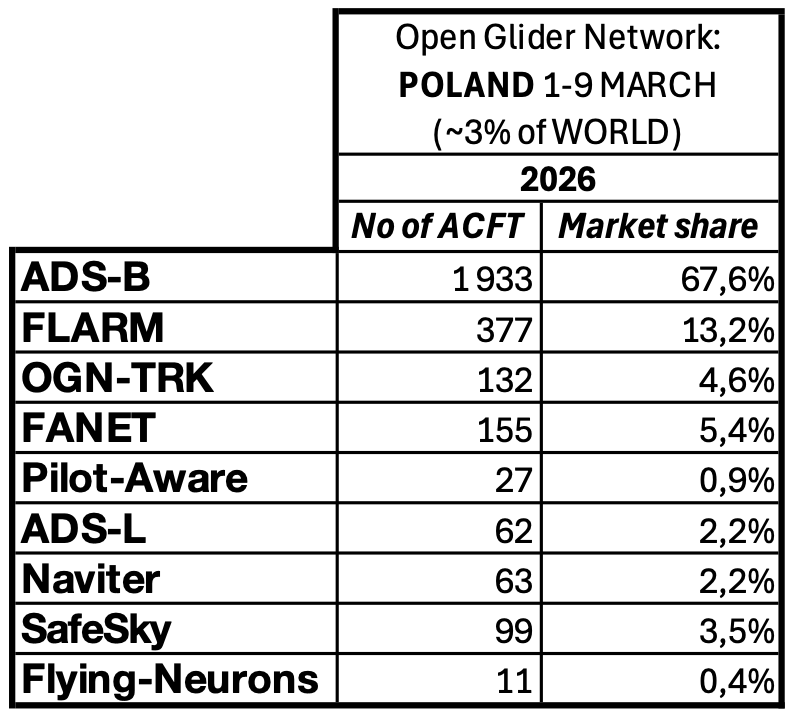
In Poland, the ratio between open and closed system devices looks quite encouraging. We can even say that open systems are winning. The OGN-Tracker gained traction relatively quickly in Central Europe, most likely due to its affordable price. Countries such as Czechia, Slovakia, Hungary, and Lithuania use quite a number of these devices, many of them homebuilt designs.
Two large aeroclubs in Poland have installed OGN Trackers in their club gliders, and a considerable number of aircraft, mainly ultralights carry Stratux units or their derivatives to visualise traffic during flight. Poland also has a domestic manufacturer producing OGN and ADS-L equipment.
Will we eventually see a single common standard?
For now, everything suggests that the air will continue to be filled with many different “languages” for quite some time.
We are aware that this is only the beginning of the flying season, and more representative results will emerge over time. We plan to conduct a similar comparison in July 2026, when the season is in full swing. At that point, we will try to draw more definitive conclusions.
In summary
One thing is certain: the world of Electronic Conspicuity remains a technological mosaic. ADS-B dominates, FLARM maintains a strong position in its niche, while newer solutions such as ADS-L are trying to find their place. Whether they will succeed, time will tell.















Komentarze